
Pause Reboot 19.6 Review: One Year of Full-Time Overland Travel
You can buy a trailer based on a spec sheet, marketing slogans and promises. Or you can buy it based on how it actually performs after a year of real use. This article is about the second option.
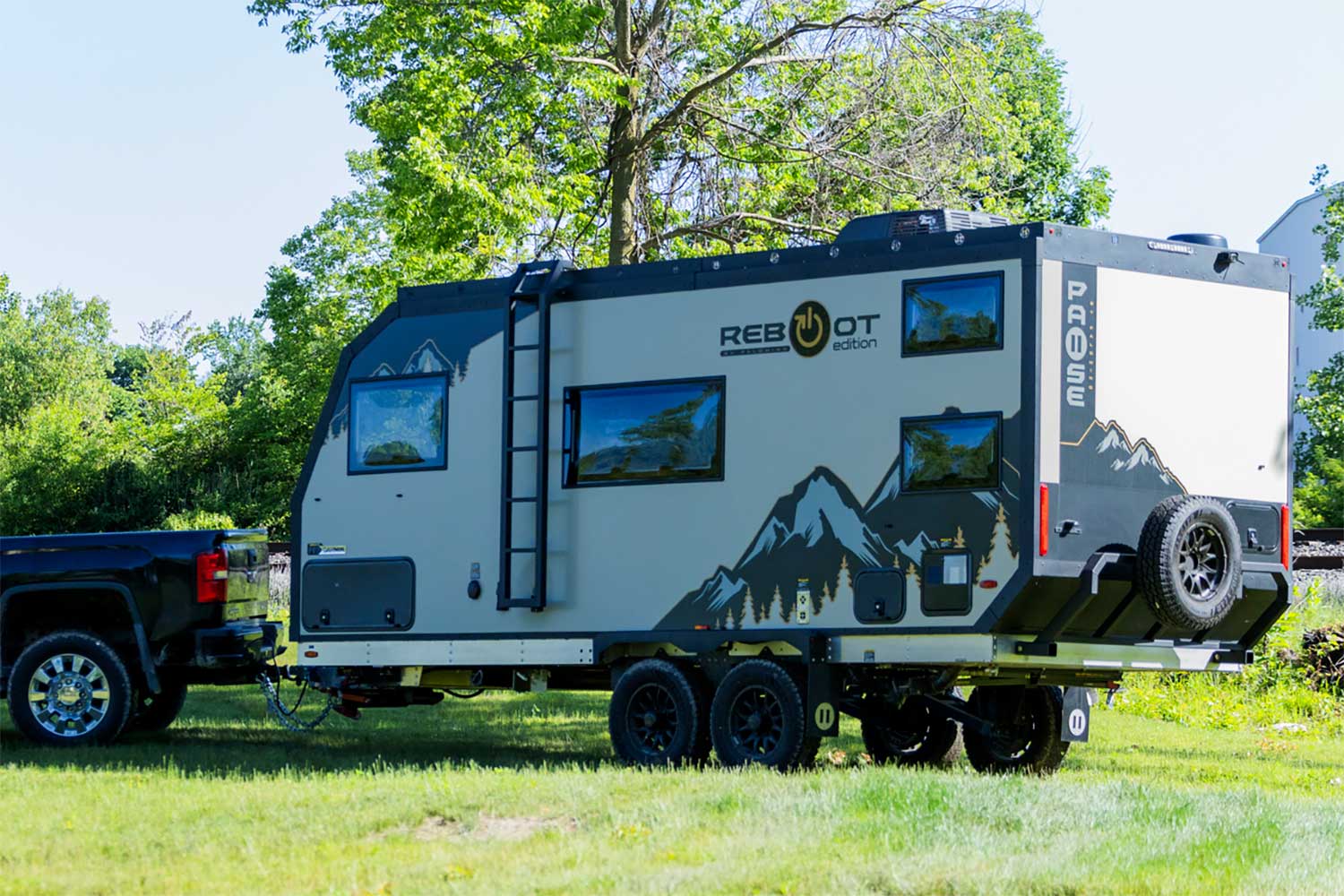
As of October 7 when I am writing this article, for 392 days, we lived full-time in our own Reboot 19.6 while always staying off-grid. We travelled through British Columbia, the Yukon and the Northwest Territories, all the way to the Arctic Ocean, and finished where we started: in the Bella Coola Valley. We’ve been through rain, mud, snow, high winds, river crossings, ocean air, lakes. You name it.
The trailer covered almost 16,000 kilometres. That is trailer mileage, not truck mileage. Roughly 40% of it was off the highway: gravel, forest service roads and the occasional stretch of heavy off-road driving.
Let us give you the answer first. We rate our Reboot 19.6 at 9 out of 10, or 8.5 if we are being strict. Would we buy it again? Yes. Below, we go through every part of the trailer and explain exactly why it earned that score, what broke, what annoyed us, and how we fixed it.
A note on transparency
Overland WBA is the authorized Pause distributor in Canada, so yes, we sell these trailers. We also own this one and live in it. That is precisely why this review lists every problem we had. An honest list of flaws is more useful to you than another brochure.
The Verdict at a Glance
The things that really matter are solid. The things that annoyed us are small, and every one of them can be fixed by the owner.
| System | How it performed | What to know |
|---|---|---|
| Chassis and frame | Excellent | No issues of any kind after 16,000 km |
| Underbelly protection | Excellent | A few screws backed out; check monthly |
| Air suspension | Excellent | Minor surface rust on steel components |
| Onboard air | Good | Pressure switch failed after the Dempster Highway |
| Side walls, rear wall and roof | Excellent | No leaks, strong thermal performance |
| Front section | Fair | Thermal bridging at the front corner joint |
| Side windows | Very good | Two had sealing problems early on; all solved |
| Front window | Fair | Weaker thermal performance than the side windows |
| Articulating hitch | Very good | Re-locking it on uneven ground takes effort |
| Tongue jack | Excellent | Clean and lubricate it weekly on dirty roads |
| Truma water heater | Excellent | No issues |
| Truma furnace | Good | Replaced once under warranty; later fault was wiring |
| Solar, roof, AC, MaxxAir | Excellent | Nothing to report |
| Tires and brakes | Excellent | Nothing to report |
| Outdoor kitchen | Excellent | Magnetic cutting board will not stay in place |
| Entry steps | Good | Strong, but they carry dirt inside when stowed |
| Entry door and locks | Average | Weak insulation, finicky locks |
| Interior and cabinetry | Very good | One cabinet latch, loud Victron fans |
| Humidity control (front) | Fair | Needs owner solutions in humid climates |
How We Tested It
A review is only as good as the conditions behind it. A trailer that spends ten weekends a year in serviced campgrounds will tell you very little about long-term durability. Ours did not have that kind of year.
- Duration: 392 days of full-time living. Every day, every night.
- Distance: almost 16,000 km on the trailer itself.
- Road surface: roughly 60% highway and 40% gravel, forest service roads and heavier off-road sections.
- Route: British Columbia, the Yukon and the Northwest Territories, including the Dempster Highway to the Arctic Ocean.
- Seasons: all four, from summer heat to northern winter.
- Crew: two adults and one dog.
Our unit
A few words about where the Reboot sits in the family. Restart is the core overland lineup. Reboot sits in the middle and is highly customizable. Pause is the flagship. If you want to see how the three compare in detail, read our Pause vs Reboot vs Restart comparison.
Our unit is equipped with MORryde air suspension, the Truma package, fully upgraded power package and an outdoor kitchen.
Let’s begin, shall we?
1. Chassis, Frame and Underbelly
The Frame
Reboot uses a MORryde huck-riveted, heavy-duty aluminum full-perimeter chassis. After a year and 16,000 km, we have not found a single issue. No cracks, no loosening, no signs of fatigue. Nothing.
The aluminum framing makes this trailer feel like a tank. And this is not only about the exterior. The cabinetry, the bed and the dinette are all seated on and connected to that aluminum structure, so the interior feels just as robust as the outside.
Verdict: the foundation is excellent. This is the part of the trailer an owner cannot upgrade later, and it is the part Reboot gets most right.
The Underbelly
The aluminum plates beneath the trailer provide real protection, and we tested that by accident.
While crossing McDonald Creek in northern BC, we caught a large rock under the trailer and dragged it for about 10 metres. The creek was so loud that we did not hear a thing. We only noticed after stepping out. The damage? None at all.
What we noticed: around the ten-month mark, three or four of the underbelly screws began to back out. This left small gaps between the plate and the frame. The original 1/4-inch screws would no longer hold in their holes.
How we fixed it: we replaced them with 5/16 x 1-inch screws and resealed the gaps with foam sealant.
Our advice: if you own a Reboot or a Pause, look underneath once a month. Check the screws and make sure everything is tight. It takes five minutes.
2. Air Suspension and Onboard Air
MORryde Air Suspension
Our Reboot is equipped with MORryde independent air suspension, and what a miracle it is.
First, levelling feels like cheating. We control it from the tablet inside the trailer or from the app on a phone. It does not matter how uneven the ground is. Levelling takes a minute or two, and there are no blocks involved.
Second, it greatly softens the ride. One day we left a bowl of soaked wild rice on the counter and drove off. Ten or fifteen minutes down a forest road, we remembered it. We stopped, ran back and opened the door. No splashes. The bowl was sitting exactly where we had left it.
That story explains better than any specification why the cabinetry, appliances and plumbing in this trailer have survived 6,000-plus kilometres of rough roads.
What we noticed: the frame is aluminum, but some suspension components and side brackets are steel. After a year of mud, snow and coastal air, they show light surface rust. This is cosmetic at this stage. We will clean and treat them once we are back on Vancouver Island.
Compressor and Air Tank
Air is supplied by an onboard compressor and tank. Both worked flawlessly until we returned from the Dempster Highway, which is a very long and very dusty road.
What failed: the pressure switch. This small part keeps tank pressure within a set range automatically. When pressure drops below the lower limit, it starts the compressor. When it reaches the upper limit, it stops it.
Where we are now: the compressor itself is fine. We can start and stop it manually, so the suspension remains fully usable. The replacement switch costs about $40, and swapping it will restore automatic operation.
Verdict: the suspension is one of the best things about this trailer. A $40 part after the Dempster does not change that.
3. Walls, Roof and Thermal Performance
Side and Rear Walls
Reboot walls are built in five layers: exterior fibreglass, Azdel composite, EPS insulation, a second layer of Azdel and interior fibreglass.
In one year, we had no leaks through the walls whatsoever. Thermal performance was really good as well. In summer, the walls stayed cool to the touch for a very long time. In winter, they held the warmth. You still need to run the furnace, of course, but it does not have to work nearly as hard.
Roof
No issues and no leaks. The roof is insulated above and below the aluminum trusses, and you can walk on it. The solar panels, air conditioner and MaxxAir fan all performed without a single complaint.
The roof ladder deserves its own mention. It is massive, solid and one of our favourite features on the trailer.
The Front Section
This is the one area of the envelope where we have a real remark.
On hot days, the side walls stayed cool on the inside. The joint where the two front walls meet did not. Behind the interior trim, we could feel warmth coming through. That told us there was thermal bridging at that connection.
How we fixed it: the interior trim panel comes off easily. We placed reflective bubble insulation behind it, reinstalled the panel and finished the edge with multi-purpose weather seal. The heat stopped coming through.
It is a simple fix, and it is something the factory could address on future units.
Window Frames
The dual-pane windows insulate well, and so do the walls. The window frames are the weak point between them. In strong sun, the frames became noticeably warm on the inside.
How we fixed it: we cut a piece of reflective bubble insulation for each window and attached it with Velcro. It goes on in seconds, comes off in seconds, and it meant we did not need to run the AC all day.
4. Windows
Side Windows
The dual-pane acrylic side windows performed really well. No damage after a year of branches, gravel and dust, and good thermal performance.
We did have sealing problems early on, and they are worth explaining in full.
Problem one: when we received the trailer, two windows had not been assembled properly and let water in. We contacted Pause, and they immediately shipped two new windows to the nearest Forest River dealer. The replacement itself took about an hour. Quick and painless.
Problem two: one of the replaced windows still let water through in heavy rain. We later learned that the seal on the inside had not been done properly. This affected some units, not every unit. Ours happened to be one of them. Other owners have fixed it by opening the window assembly and correcting the seal.
How we fixed it: we were travelling through remote communities with no dealer anywhere near us, so we needed something we could do on the spot. We applied heavy-duty Gorilla tape along the top of the window, where the wall meets the upper frame. That was six or seven months ago. The tape still looks like it went on yesterday, and the window has not leaked since.
The factory would sort this out properly if we asked. On the road, the tape was an easy, headache-free solution.
It was also a good lesson. When you travel full-time, you do not always have access to an RV technician. You need to be creative and solve things right away.
Front Window
The front window is a different type from the side windows, and its thermal performance is not as good.
- In summer: the same reflective insulation with Velcro solves it completely.
- In winter: last year we added a clear plastic sheet to trap a layer of air and improve insulation. This winter we plan to try a different approach.
5. Hitch and Tongue Jack
MORryde Articulating Hitch
The articulating hitch is heavy-duty and performed very well. No failures and no wear worth mentioning.
It has two positions. In the locked highway position, it still offers some flexibility, and combined with the suspension, that is all you need for pavement and light off-road driving. When the ground becomes seriously uneven, you release it. The hitch can then move left and right, up and down.
What we noticed: going back to highway position is not always easy. The pivoting section has to line up before it slides back in. If the truck and trailer are sitting at different angles, it will not line up, and you will struggle with it.
Our advice: find a flat spot before you re-lock the hitch. We would call this an extra inconvenience, not a flaw. Perhaps there is a better design solution out there.
Electric Tongue Jack
No issues at all. One thing to be aware of: the lower part of the jack is open, so on dusty and muddy roads it collects debris.
Our advice: once a week on dirty roads, look underneath, clean out the mud and apply a dry lubricant. It will keep serving you.
A-Frame Storage
The coated A-frame storage box did its job. The air tank and propane tanks stayed protected through everything. The only remark is its lock, which we cover in section 7.
6. Truma Heating and Water Systems
Water Heater and Water Bay
No issues with the Truma water heater. No issues with the water management bay. All good here.
Truma Furnace
The furnace gave us two separate episodes, and only the first one was actually about the furnace.
Episode one, winter 2026: the furnace stopped working. We called Truma, and they walked us through the first checks. We then went to an RV dealer, where the propane regulator, line pressure and pressure at the furnace were all tested. The Truma technician joined the dealer’s technician by phone. They could not determine the cause, so Truma shipped a new furnace to that dealer and it was replaced.
Episode two, about eleven months in: the new furnace started acting up. This time the cause was found. The voltage reaching the furnace was not consistent. The wiring between the furnace and a push-in wire connector had become unreliable, and the furnace was shutting down on its own safety protection.
How we fixed it: we removed that connector and replaced it with a regular twist-on connector. Problem solved.
So the second issue was not a Truma issue at all. It was a wiring connection after eleven months of vibration on the road.
Our advice: if your furnace begins to misbehave after a lot of rough-road travel, check the supply voltage and the wire connections before assuming the furnace has failed.
7. Exterior Equipment
Tires, Brakes, Camera and Lights
Nothing to report. After this kind of mileage, that is exactly what you want to read.
Outdoor Kitchen
The outdoor kitchen performed really well. No issues with the fridge and none with the grill.
Having two fridges turned out to be a blessing. Our dog eats raw food, and on long stretches without a proper grocery store, the extra cold storage makes a real difference.
What we noticed: the cutting board is held in place by magnets, and they are not strong enough for forest service roads. Every time we arrived, the board was somewhere inside the compartment. We eventually put it in storage. A minor complaint.
Entry Steps
The MORryde steps are strong, and nothing broke. We added a small piece of carpet because our dog is getting older and occasionally caught a leg in the open tread.
What we do not like: the steps fold up and store inside the doorway. It sounds like a great idea in theory. In practice, you carry all the mud from the steps into the trailer and have to clean it every time.
External Solar Port
The port for portable solar panels does not have enough protection from the elements. On the Dempster, it was exposed to dust, mud and snow.
How we fixed it: a plastic cover from a hardware store, attached with double-sided Velcro. Yes, Velcro again. It is our go-to tool.
Entry Door
The entry door is a typical RV door, and we are not big fans of it. It looks fine, but its thermal qualities do not match the rest of the trailer.
How we fixed it: the same reflective insulation panel we use on the windows, attached with Velcro in summer.
Locks
This is our biggest annoyance. Let’s put it this way: the locks are average.
Several times, the key went in and simply would not turn. You wiggle it, play with it, and eventually it opens. After a full year, two compartment locks reached the point where the key would not open them at all. We had to break them open with tools. The lock on the A-frame storage can be just as unfriendly.
It is not a big deal. It is annoying, and it is one of the main reasons this trailer is not a 10.
8. Interior and Humidity
What Simply Worked
The fridge, the bunk beds, the water pump and everything kitchen-related gave us no issues at all in 392 days of daily use. There is not much to comment on, which is a good sign.
Humidity at the Front
In the mountains and in dry regions, the front of the trailer stayed as dry as the rest. Camped next to the ocean, it was a different story. The front section, the same area where we found thermal bridging, showed visible moisture.
Nobody could tell us what to do about it, so we worked it out ourselves. Three things solved it:
- A full-size dehumidifier. Not a small RV unit. A proper household dehumidifier.
- An air circulator. Not a fan, a circulator. We consider it a must-have in any trailer. In summer it also helps the trailer stay cooler for longer when the AC is running. In winter it spreads the warm air, so you do not burn through propane as quickly.
- A ventilation mat under the mattress. We use HyperVent, a marine-grade mat that keeps the mattress off the bed platform and lets air move underneath.
Victron Cooling Fans
The Victron Energy system sits under the dinette bench and is cooled by two fans. They are loud. This is a common complaint in the Pause owner community, and many owners replace them with quieter fans. We have not done so yet.
Cabinet Latches
All the cabinets are designed to stay locked while driving off-road, and almost all of them did.
The largest cabinet was the exception. It kept opening on rough roads. We adjusted the hinges more than once, and it would still be open on arrival. In the end we added a manual latch and, of course, Velcro. It has not opened since.
One more latch broke during the year, most likely from off-road vibration. We do not blame Pause for this one. We are simply showing you everything that broke in 365 days on the road.
Our Add-On: Water Filtration
We installed a multi-stage filtration system for drinking water. It is a personal upgrade, not a fix, and one we would recommend to anyone living in a trailer full-time.
Everything That Went Wrong in 365 Days
Here is the complete list in one place. Notice what is on it, and what is not: nothing structural, nothing that stopped the trip.
| Issue | Cause | Our fix | Status |
|---|---|---|---|
| Two windows leaking at delivery | Assembly | Pause shipped two new windows; dealer replaced them in about an hour | Solved under warranty |
| One of the replaced windows leaking in heavy rain | Interior seal | Heavy-duty Gorilla tape along the top frame | Solved; holding for 6–7 months |
| Furnace stopped working | Not determined | Truma replaced the furnace | Solved under warranty |
| Furnace cutting out again | Unstable voltage at a wire connector | Replaced with a twist-on connector | Solved |
| Compressor pressure switch | Dempster Highway dust | Manual operation for now; about $40 part | Replacement pending |
| Underbelly screws backing out | Vibration | 5/16 x 1-inch screws and foam sealant | Solved |
| Surface rust on steel suspension parts | Mud, snow, coastal air | Clean and treat | Pending |
| Heat at front corner joint | Thermal bridging | Reflective insulation behind the trim | Solved |
| Warm window frames, door and front window | Lower insulation than the walls | Reflective panels on Velcro | Solved |
| Moisture at the front near the ocean | Humidity and thermal bridging | Dehumidifier, air circulator, HyperVent | Solved |
| Two compartment locks | Keys stopped turning | Forced open | Locks need replacing |
| Largest cabinet opening off-road | Latch and hinges | Manual latch and Velcro | Solved |
| One cabinet latch broken | Off-road vibration | – | Needs replacing |
| Outdoor cutting board falling off | Weak magnets | Removed | Not used |
| Exposed external solar port | Limited weather protection | Plastic cover on Velcro | Solved |
That is fifteen items in a year of full-time, four-season use. Two were handled under warranty. One costs $40. The rest were solved with tape, Velcro, a few screws and some reflective insulation.
Owner’s Checklist and Recommended Upgrades
If you own a Reboot or a Pause, or are about to, this is the practical part.
Routine Checks
- Weekly on dirty roads: clean the tongue jack and apply dry lubricant.
- Monthly: inspect the underbelly and tighten any screws that have started to back out.
- After long dusty stretches: check the compressor area and confirm the tank is cycling automatically.
- Seasonally: inspect steel suspension components and treat any surface rust early.
- Before releasing the hitch: plan to re-lock it on level ground.
- If the furnace acts up: check supply voltage and wire connections first.
What We Carry Now
- Heavy-duty Gorilla tape
- Double-sided Velcro, and plenty of it
- A few spare 5/16 x 1-inch screws
- Foam sealant and multi-purpose weather seal
- Twist-on wire connectors
- Dry lubricant
Upgrades We Recommend
- Reflective bubble insulation panels cut to fit each window, the front window and the entry door
- An air circulator for year-round comfort and lower propane use
- A household dehumidifier if you camp in coastal or humid regions
- A HyperVent mat under the mattress
- A cover for the external solar port
- A multi-stage drinking water filter
- Quieter replacement fans for the Victron compartment, if the noise bothers you
Frequently Asked Questions
Is the Reboot 19.6 good for full-time living?
Yes. We lived in ours every day for a year, through all four seasons, with two adults and a dog. The structure, suspension, power and water systems all supported full-time use without any major failure.
How does the Reboot 19.6 handle off-road travel?
Very well. About 40% of our 16,000 km was on gravel, forest service roads and rougher terrain, including the Dempster Highway. The chassis showed no issues, and the air suspension protected the interior from vibration.
Is the Reboot 19.6 a true four-season trailer?
We prefer the term multi-season. The walls and roof hold temperature very well in both heat and cold. The front section, front window, window frames and entry door are weaker and benefit from simple added insulation.
What are the most common problems with the Reboot 19.6?
In our experience: finicky compartment locks, an entry door with modest insulation, window sealing on some units, loud Victron cooling fans and humidity at the front in coastal climates. None of them are structural.
Does the Reboot 19.6 leak?
The walls and roof did not leak at all. Three windows on our unit had sealing problems early on. Two were replaced under warranty and the third was sealed with tape. We have had no water intrusion since.
Is the MORryde air suspension worth it?
For the way we travel, absolutely. It levels the trailer in a minute or two without blocks, and it noticeably reduces shock and vibration inside the trailer.
Would you buy the Reboot 19.6 again?
Yes. We do not think there is a better overland trailer in this price range that delivers the experience we had. If we wanted even more, the next step would be the flagship Pause lineup.
Final Verdict
As promised at the beginning: 9 out of 10. If we are being strict, 8.5.
We cannot give it a 10. There are too many small annoyances for that: the locks, the entry door, the front window, a cabinet that would not stay shut.
But look at where those annoyances are, and where they are not. The chassis, the suspension, the walls, the roof, the overall build quality. All the things that really matter are solid.
Would we choose a trailer with excellent locks and a mediocre structure instead? No. A lock can be replaced. A door can be replaced. The frame, the suspension and the envelope are what hold a trailer together, and those cannot be fixed with Velcro.
What you are looking at is 392 days of full-time living and 16,000 kilometres. We think that is a statement.
The best trailer is not the one with the perfect spec sheet. It is the one that is still solid after a year of doing what it was designed to do.
Thank you for reading. If you have any questions about our experience, let us know.
About the author
Serge Orlov has lived full-time on the road in a Reboot 19.6 with his wife and their dog since September 2025. He writes Overland WBA’s buyer guides from that real-world experience: towing, off-grid power and daily life in a Pause trailer. Follow the journey on his YouTube channel, Grey Whale Tales and Trails.
Thinking About a Reboot 19.6?
See the full specifications, floorplan and virtual tour of the trailer we lived in for a year.
Not Sure Which Lineup Fits You?
Restart, Reboot and Pause offer different levels of construction, suspension and off-grid capability.
Have a Question for Someone Who Lives in One?
We are happy to share what we have learned on the road.